


“The importance of preventing well known characters from being misused for commercial products lies in the fact that the creation of fictional characters requires a great amount of creativity and an innovative mind.”
- Delhi High Court in Disney Enterprises, INC & Anr. v. Pankaj Aggarwal & Ors.
Introduction
Across the world, entertainment has been a source of escape for almost everyone. Whether it’s a book, comic, movie, serials, video games or maybe now reels. This escape or desire for being entertained has spawned over the years, a massive proliferation of multiple fictional characters which have been etched into people’s memory. While there is content available such as documentaries and biographies, it’s this make-believe characters and their world which has led to development of humungous pop-culture across countries where these fictional characters are enjoyed and celebrated as one of our own. Whether its Godzilla, King Kong, ET, James Bond, Sherlock Holmes, Mr. Bean, Uncle Scrooge, even Batmobile or our very own Nagraj, Chacha Chaudhry, Chhota Bheem, Crime Master Gogo; they all have a huge fan following across generations. However, the question which begs consideration is: What has been the jurisprudence towards protection of such characters?
The need for protection
The popular fictional characters have value as people tend not only to have them as part of the content in which they appeared, but closer to them in their daily lives as fans. These characters can be seen in some manner or another around us on vendible items such as dolls, magnets, mugs, cups, school bags, T-Shirts, caps, watches, wrist bands, masks, book holders, book marks, bottles, theme parks, theme cruises, note pads, ceramic holders, journals, baggage tags, crocs, keychains etc. and aid in increasing the saleability of the products to which they have been applied to. Since, they aid in increasing sales of a product which may or may not sell if it does not have characters image, name, indicia etc., they impart value to goods and thus there is a need for protection for them.
Even apart from above, even if an entity has not licensed its characters for use for merchandising, these characters still need protection as their value lies in selling their subsequent issues which for successful characters are in high anticipation. For example, in comic books, series or in movies that have direct sequels; the anticipation increases if the characters are being repeated. On the other hand, if the sequels are mere spiritual sequels the anticipation of the audience goes down impacting the film’s revenues.
However, the above reasons are not the only reasons. The above reason are highly commercial reasons on the need for protection of fictional characters. Apart from the above, the need for protection goes back to the first principle of Copyright protection, i.e. to act as an incentive and encouragement to authors to continue their endeavours towards creativity. If an author/creator is not protected (which leads to other rewards such as monetary gains and recognition) for its writing original characters, it might loose the inclination to think something out of the box, the work produced then may be a something underdeveloped, having a low retention value and thus limited ability to give returns. On a larger level, such a situation may not be conducive even for the economy of the nation which could reap benefits due to popularity or monetization of character. No wonder, the Indian Government is taking steps towards strengthening its Orange economy. The Government of India in February, 2026 proposed to support the IICT Mumbai in setting up AVGC content creator labs in 15,000 secondary schools all over the country and 500 colleges.
The Tests for Protection
Over the years, the Courts have formulated few tests so as to determine protectability of fictional characters. In, Anderson v Stallone , it was observed that in Nichols v. Universal Pictures the test set out to grant copyright protection to a character is ‘if it is developed with enough specificity so as to constitute protectable expression.’ The Court also observed that in Warner Bros. Pictures, Inc. v. Columbia Broadcasting System, Inc. , no copyright protection was given to the literary character Sam Spade since it did not constitute the story being told (also known as ‘story being told test’).
Having observed both the tests and also observing that the ‘story being told test’ is more restrictive, while discussing their applicability; the Court applied both the tests to the case of Rocky Balboa as a matter of abundant caution and found the character protectable under both tests. The Court found Rocky Balboa to be a highly delineated character as his name is the title of all of the Rocky movies and his character has become identified with specific character traits ranging from his speaking mannerisms to his physical characteristics. Further, the Court found that the Rocky characters were so highly developed and central to the three movies that they ‘constituted the story being told’. It was ultimately held that the Rocky characters Rocky, Adrian, Apollo Creed, Clubber Lang, and Paulie 'constituted the story being told’.
Over the years, multiple fictional characters have been protected by Courts such as Disney characters such as Mickey Mouse , E.T. The Extra-Terrestrial , James Bond , Godzilla , Batman and even Batmobile . In the James Bond case, irrespective of the fact as to how each actor portraying James Boon looks like, it was accorded protection since James Bond always maintains his “cold-bloodedness; his overt sexuality; his love of martinis ‘shaken, not stirred;’ his marksmanship; his ‘license to kill’ and use of guns; his physical strength; [and] his sophistication.
In the case, where rights were being claimed on Batmobile, the United States Court of Appeal for the Ninth Circuit, went through multiple decisions on the issue of copyrightability of characters and culled out three tests for their protection:
i. The character must generally have “physical as well as conceptual qualities”;
ii. The character must be “sufficiently delineated” to be recognizable as the same character whenever it appears. Considering the character as it has appeared in different productions, it must display consistent, identifiable character traits and attributes, although the character need not have a consistent appearance; and
iii. Third, the character must be “especially distinctive” and “contain some unique elements of expression. Even when a character lacks sentient attributes and does not speak (like a car), it can be a protectable character if it meets this standard.
The Court found Batmobile to fall under all the three tests and granted it protection.
The India Story
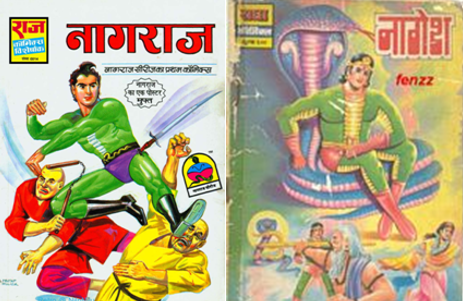
In India, the earliest case which appears to have protected the fictional characters appears to be VT Thomas v. Malyala Manorama . The decision does not deep dive much into the tests for character protection but finds the characters ‘Boban and Molly’ to be property of the author Mr. VT Thomas. Similarly, the comic book character ‘Nagraj’ was protected by the Hon’ble High Court of Delhi in Raja Pocket Books v. Radha Pocket Books . An illustrative image of the characters of the respective parties as depicted on their comic books is provided herein below:
Interestingly, in Star India Private Limited v. Leo Burnett (India) Private Limited & Anr., a somewhat peculiar situation arose so far as protection of characters is concerned. The Defendant used the same actors who played certain characters on the show ‘Kyun Ki Saas Bhi Kabhi Bahu Thi’ for a television commercial. The Plaintiff, inter alia, sued for passing off on the basis of a potential claim for character merchandising. However, the Hon’ble Court did not grant relief to the Plaintiff, inter alia, on the grounds that:
a. There was no passing off as activities were different;
b. The Plaintiff had not licensed its character for merchandising;
c. None of the actors have acquired such fame or a character has been identified in the minds of the public;
d. There is nothing to show that the characters Tulsi, Savita or J.D. by themselves are capable of being marketable independently or jointly; and
e. The characters are played by ordinary people in real life and there is no fictional character involved.
In this case, the show in question was launched in the year 2000 and the advertisement came somewhere in 2002. Probably for these reasons, the Hon’ble Court did not find goodwill or fame in the characters themselves. Having said that, the fact that the Defendant did use the characters from a popular show running at that point of time creates an inference that it was to attract the consumers and utilise the fame of the show. May be there was a case for tort of unjust enrichment since it was due to efforts of probably the channel or the show makers that their show was popular, the utilisation of the same was right of entities who invested that time, effort and resources towards it. If a show was popular obviously the actors become popular and are associated with the show in question. It is difficult to fathom that no consumer would have believed that the advertisement had no association or collaboration with the show. If filed in today’s time, may be the result for the Plaintiff would have been different.
In Disney Enterprises, INC & Anr. v. Gurcharan Batra & Ors. the Disney characters were protected against misappropriation of unauthorised use on school bags in an ex-parte decision. Similarly, in Disney Enterprises, INC & Anr. v. Santosh Kumar & Anr. the trademarks and copyright in the characters of ‘Hannah Montana’, ‘Donald Duck’, ‘Mickey Mouse’, ‘Winnie the Pooh’ etc. were protected in an ex-parte decision where the Defendants were using the characters on examination boards.
In Sholay Media and Entertainment Pvt. Ltd. and Anr. v. Parag Sanghavi and Ors. the Plaintiffs had argued that characters such as ‘Gabbar Singh’, ‘Jai’, ‘Veeru’, ‘Basanti’, ‘Radha’, ‘Thakur’, ‘Dhanno’ and ‘Sambha’ are well developed, unique and distinctive making them sufficiently delineated. It was further argued that the characters ‘Gabbar Singh’, ‘Jai’, ‘Veeru’, ‘Basanti’, ‘Radha’ and ‘Thakur’ are so central to the entire plot that they constitute 'the story being told test. Without going into the analysis of these tests vis-à-vis characters, since the Court found similarity in characters in the film ‘Sholay’ as compared to the film ‘Ram Gopal Varma Ki Aag’ along with other factors such as plot it held there is infringement of Copyright. This was also an ex-parte decision.
In Disney Enterprises, INC & Anr. v. Pankaj Aggarwal & Ors. the Defendant used the depiction of the lead character from the film ‘Cars’, i.e. ‘Lightning McQueen’ on its chocolates. The Hon’ble Court in this decision observed that it is well settled that characters can acquire the status of trademark and can also be protected under copyright law. Interestingly, the Hon’ble Court gave further rationale for protection of the fictional characters by observing that characters such as ‘Lightning McQueen’ have transcend movies as children recognise such characters and treat them lie living human and it is not uncommon for children wanting to buy toy cars, bags and stationery products which have images of ‘Lightning McQueen’ on them. Similar to foreign cases, the Court analyzed and found distinctive elements in the character of ‘Lightning McQueen’. This was also an ex-parte decision.
In May, 2025, an ex-parte ad interim injunction was granted against violation of characters of the film ‘Andaz Apna Apna’ such as Crime Master Gogo, Teja, Amar Prem, Robert.
Thus, decisions passed post 2010, have been more or less ex-parte where there has not been much contentions or objections raised on rights of Plaintiffs unlike foreign jurisdictions where such issues have been hotly contested. In India, contest was high in the Bobban and Molly Case, Nagraj Case and the case pertaining to characters from the teleserial ‘Kyun Ki Saas Bhi Kabhi Bahu Thi’. Having said that, there is consensus in majority of decisions that popular or famous characters are supposed to be protected. Further, in the ‘Lightning McQueen’ case, the distinctive elements were recognised. However, India has not seen its own share of cases delving on the ‘story being told test’.
Some intricacies
Sometimes there is a debate about the fact that how a character can be used if its in public domain. There are also questions that what happens when certain form of character has entered public domain, will the subsequent forms having separate traits also enter public domain.
These are highly intricate issues that crop up in character rights protection. In answer to the first, it is stated that a character in public domain may be used by an entity in subsequent works. However, they have to be sure that there are no trade mark rights being claimed over the character while its depiction is in public domain. If trade mark rights exists, they are perpetual and thus while you may use the depiction of the character but not in a sense that impacts the trade mark function of the character. For example, lets say a Character A is in public domain, that means that character can be a part of movie. However, that does not mean that one can use it to sell merchandise as that would impact the trade mark function of the mark.
On the second question, it is stated that the new forms or separate traits may be protectable separately if they are distinctive enough. There can be a separate copyright over the same, having a separate term of protection as well. In the case of Silverman v CBS, Inc. holds to this effect. This means that when a new trait is violated, violation takes place only to the extent of the new character traits.
Conclusions & Suggestions
While the Courts have laid down certain tests, the applicability of those tests to each fact based situation has to be different. For example, there have been characters that have been immensely popular but may not satisfy the ‘story being told’ test. Are they not entitled to protection, while their character attributes, manners, traits may be distinctive and merchandisable. Secondly, is it necessary to have a character merchandising plan in advance before claiming that if used on a merchandise, it amounts to passing off. Indian jurisprudence in this regard, has grey areas. In the author’s view so long as there is value on account of addition of a character it needs to be protected.
As a suggestion, it is advisable to protect these characters through various means, copyright and trade mark registrations which may even include 3-d registrations which will really help in protecting the character from unauthorised use in figurines, bobble heads etc. Apart from the same it is absolutely essential to have a surveillance in the market and one should keep issuing at regular intervals Trade mark and Copyright caution notices claiming rights over their characters. While, this article does not deal with the issue of authorship and ownership in AI-generated works, which is a subject matter of separate debate and this paper focuses only on protectability once created, it is stated that the AI platforms have enabled people across the globe to create parallel stories of popular character and disseminating the same on video sharing platforms. The same is not advised, because all of these are derivative works based on the characters. Even for fandom, which is considered as another defence to copyright violations for fictional characters; this is not a line one should tread as it impacts the Copyright owner.
On the merchandising side, the licensors are advised to have licenses products that bear a permanently affixed copyright notice and/or trademark notice. It appears that in India, we are still at a very nascent stage in investing in merchandising of fictional characters. There have only been a handful of examples. In fact, in 2013, we apparently had India’s first Hindi film based character dolls for the film Dhoom 3. So, on this front, I think India has miles to go as compared to its foreign counterparts which have developed markets.
About the author
Ankit Rastogi, Partner

Mr. Ankit Rastogi was admitted to the Bar in the year 2011. In 2021, Ankit completed his LL.M. in Intellectual Property Law from USLLS, Delhi (IP University) and received a Gold Medal from the University for standing first in the order of merit. Ankit’s core domain lies in Intellectual Property protection, enforcement and strategy. Over the years, Ankit has worked on certain important decision on Intellectual Property Rights in India, covering the issues pertaining to ‘single colour marks’, ‘reverse confusion’, ‘comparative advertising’ and ‘priority rights in trade marks’. Ankit is majorly involved in trademark, copyright & design litigations as well as transactional work in Indian Comic book space.